
The Constitution of India: A Complete Overview of All Parts & Chapters
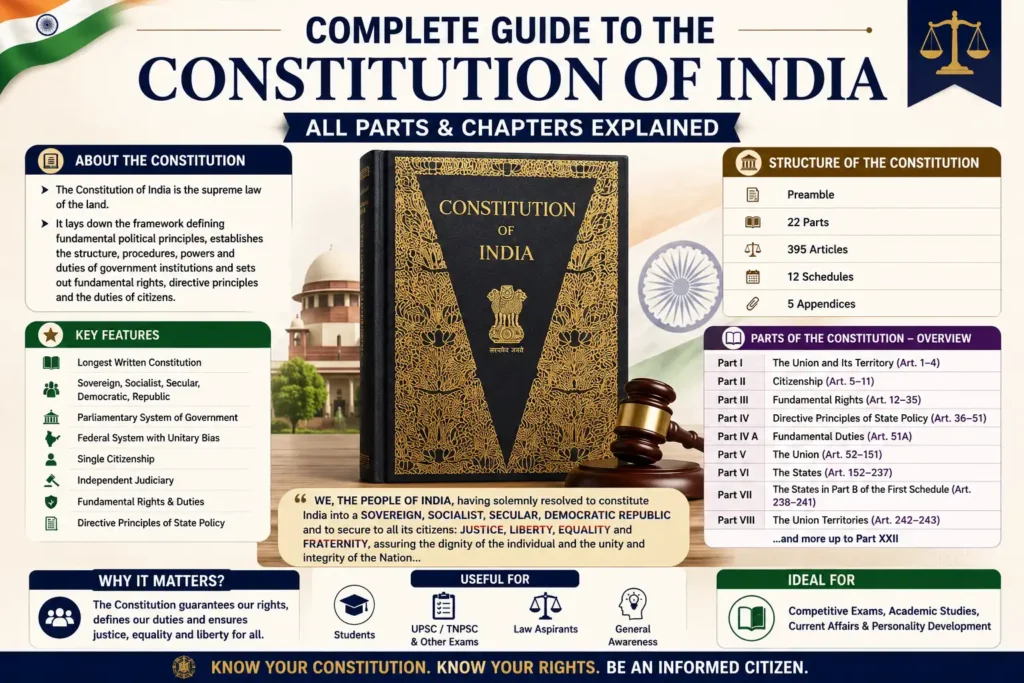
The Constitution of India is the supreme legal document of the nation. According to the official legal texts archived in the India Code, it establishes the political framework, powers of government institutions, and the fundamental rights and duties of its citizens. Below is a highly detailed, comprehensive, and simplified guide to all Parts and Chapters of the Indian Constitution, specifically structured for easy reading and reference.
The Constitution of India: A Complete Overview of All Parts & Chapters
The Constitution of India is the supreme legal document of the nation. According to the official legal texts archived in the Indian Code, it establishes the political framework, powers of government institutions, and the fundamental rights and duties of its citizens. Below is a highly detailed, comprehensive, and simplified guide to all Parts and Chapters of the Indian Constitution, specifically structured for easy reading and reference.
PART I: THE UNION AND ITS TERRITORY (Articles 1 – 4)
-
Article 1: Declares “India, that is Bharat, shall be a Union of States.”
-
Article 2: Gives Parliament the power to admit new states into the Union.
-
Article 3: Empowers Parliament to alter state boundaries, increase/decrease areas, or change the names of existing states.
-
Article 4: Laws made under Articles 2 and 3 do not require a formal Constitutional Amendment under Article 368.
PART II: CITIZENSHIP (Articles 5 – 11)
-
Article 5: Citizenship at the commencement of the Constitution for people domiciled in India.
-
Articles 6 & 7: Citizenship rights for persons who migrated from Pakistan to India, and vice versa.
-
Article 8: Rights of citizenship for persons of Indian origin residing outside India.
-
Article 9: If a person voluntarily acquires foreign citizenship, their Indian citizenship is automatically terminated.
-
Article 11: Grants Parliament the ultimate power to regulate the right of citizenship by law.
PART III: FUNDAMENTAL RIGHTS (Articles 12 – 35)
Known as the Magna Carta of India, this part protects individual liberties against state infringement.
-
Article 12 & 13: Definition of “The State” and laws inconsistent with Fundamental Rights.
-
Right to Equality (Articles 14 – 18): Guarantees equality before the law, prohibits discrimination on grounds of religion, race, caste, sex, or place of birth, ensures equal opportunity in public employment, abolishes untouchability, and abolishes titles.
-
Right to Freedom (Articles 19 – 22): Guarantees 6 democratic freedoms (speech, assembly, association, movement, residence, profession), protection against arbitrary conviction, protection of life and personal liberty (Article 21), Right to Education (Article 21A), and protection against arbitrary arrest.
-
Right against Exploitation (Articles 23 – 24): Prohibits human trafficking, forced labor, and child labor in hazardous industries.
-
Right to Freedom of Religion (Articles 25 – 28): Guarantees freedom of conscience, free profession, practice, and propagation of religion.
-
Cultural and Educational Rights (Articles 29 – 30): Protects the interests and rights of religious and linguistic minorities to establish educational institutions.
-
Right to Constitutional Remedies (Article 32): Empowering citizens to directly approach the Supreme Court for enforcement of rights via Writs (Habeas Corpus, Mandamus, etc.). Dr. B.R. Ambedkar called this the heart and soul of the Constitution.
PART IV: DIRECTIVE PRINCIPLES OF STATE POLICY (DPSP) (Articles 36 – 51)
These are non-justiciable guidelines (cannot be enforced in court) for the government to establish a social and welfare state.
-
Socialistic Principles: Ensuring adequate livelihood, equal pay for equal work, and minimization of wealth inequalities.
-
Gandhian Principles: Organization of Village Panchayats (Article 40), promotion of cottage industries, and prohibition of intoxicating drinks.
-
Liberal-Intellectual Principles: Uniform Civil Code (Article 44), free and compulsory education for children, and separation of judiciary from the executive.
-
Article 51: Promotion of international peace and security.
PART IV-A: FUNDAMENTAL DUTIES (Article 51-A)
-
Added by the 42nd Amendment Act in 1976 on the recommendation of the Swaran Singh Committee.
-
Originally 10 duties, now 11 duties (after the 86th Amendment in 2002).
-
Key Duties: Respecting the National Flag and Anthem, safeguarding public property, protecting the environment, and providing educational opportunities to children aged 6–14.
PART V: THE UNION (Articles 52 – 151)
This is the longest part of the Constitution, broken down into 5 distinct chapters.
-
Chapter I: The Executive (Articles 52 – 78): Details the powers, election, and impeachment of the President and Vice-President. It also establishes the Council of Ministers headed by the Prime Minister to aid and advise the President.
-
Chapter II: Parliament (Articles 79 – 122): Composition, duration, and officers of the Rajya Sabha (Council of States) and Lok Sabha (House of the People). It outlines legislative and financial procedures (e.g., Money Bills).
-
Chapter III: Legislative Powers of the President (Article 123): Dictates the President’s power to promulgate Ordinances during the recess of Parliament.
-
Chapter IV: The Union Judiciary (Articles 124 – 147): Establishes the Supreme Court of India, its jurisdiction (Original, Appellate, Advisory), and its role as a Court of Record.
-
Chapter V: Comptroller and Auditor-General of India (CAG) (Articles 148 – 151): Defines the guardian of the public purse, responsible for auditing accounts of the Union and State governments.
PART VI: THE STATES (Articles 152 – 237)
Parallels the structure of Part V but applies strictly to State Governments.
-
Chapter I: General (Article 152): General definitions regarding States.
-
Chapter II: The Executive (Articles 153 – 167): The Governor (appointed by the President) and the state Council of Ministers headed by the Chief Minister.
-
Chapter III: The State Legislature (Articles 168 – 212): Bicameral (Legislative Assembly & Legislative Council) or Unicameral setups across various states.
-
Chapter IV: Legislative Power of the Governor (Article 213): Governor’s power to issue ordinances when the state legislature is not in session.
-
Chapter V: High Courts for States (Articles 214 – 232): Constitution, structure, and powers of High Courts.
-
Chapter VI: Subordinate Courts (Articles 233 – 237): Regulations for District Courts and lower judiciary.
PART VII: STATES IN PART B OF THE FIRST SCHEDULE (Article 238)
-
Repealed: This part was officially deleted by the 7th Constitutional Amendment Act, 1956, when the classification of States (Part A, B, C, D) was abolished to reorganize states on a linguistic basis.
PART VIII: THE UNION TERRITORIES (Articles 239 – 242)
-
Deals with the administration of Union Territories (UTs) directly by the President through an Administrator or Lieutenant Governor.
-
Article 239AA: Special provisions concerning the National Capital Territory of Delhi (providing a legislative assembly and council of ministers).
PART IX: THE PANCHAYATS (Articles 243 – 243O)
-
Added/revamped by the 73rd Constitutional Amendment Act, 1992.
-
Establishes a mandatory 3-tier system of rural local self-government: Gram Panchayat (village), Panchayat Samiti (block), and Zilla Parishad (district).
PART IX-A: THE MUNICIPALITIES (Articles 243P – 243ZG)
-
Added by the 74th Constitutional Amendment Act, 1992.
-
Provides constitutional status to urban local bodies: Nagar Panchayats, Municipal Councils, and Municipal Corporations.
PART IX-B: CO-OPERATIVE SOCIETIES (Articles 243ZH – 243ZT)
-
Added by the 97th Constitutional Amendment Act, 2011.
-
Deals with the voluntary formation, autonomous functioning, democratic control, and professional management of co-operative societies.
PART X: THE SCHEDULED AND TRIBAL AREAS (Articles 244 – 244A)
-
Provides special administrative frameworks for certain tribal pockets to preserve their unique culture and social systems.
-
It is closely linked to the Fifth Schedule (Scheduled Areas in general states) and the Sixth Schedule (Tribal Areas in Assam, Meghalaya, Tripura, and Mizoram).
PART XI: RELATIONS BETWEEN THE UNION AND THE STATES (Articles 245 – 263)
-
Chapter I: Legislative Relations (Articles 245 – 255): Distribution of legislative powers between Parliament and State Legislatures through the three lists (Union, State, and Concurrent Lists).
-
And Chapter II: Administrative Relations (Articles 256 – 263): Outlines coordination between Central and State executives, including the creation of the Inter-State Council to resolve disputes.
PART XII: FINANCE, PROPERTY, CONTRACTS, AND SUITS (Articles 264 – 300A)
-
Chapter I: Finance (Articles 264 – 291): Tax distribution, Consolidated Fund of India, Contingency Fund, and the Finance Commission (Article 280).
-
Chapter II: Borrowing (Articles 292 – 293): Rules for the Central and State governments regarding borrowing money.
-
Chapter III: Property, Contracts, Rights, Liabilities, Obligations, and Suits (Articles 294 – 300): Legal status of government assets and litigation.
-
Chapter IV: Right to Property (Article 300A): Originally a Fundamental Right (Article 31), it was shifted here by the 44th Amendment Act (1978) to become a purely Constitutional/Legal Right.
PART XIII: TRADE, COMMERCE, AND INTERCOURSE WITHIN INDIA (Articles 301 – 307)
-
Guarantees the freedom of trade, commerce, and movement of goods throughout the territory of India without arbitrary state barriers.
PART XIV: SERVICES UNDER THE UNION AND THE STATES (Articles 308 – 323)
-
Chapter I: Services (Articles 308 – 314): Provisions regarding All India Services (IAS, IPS, IFoS) and state civil services.
-
Chapter II: Public Service Commissions (Articles 315 – 323): Establishes the UPSC (Union Public Service Commission) and SPSCs (State Public Service Commissions) for merit-based recruitment.
PART XIV-A: TRIBUNALS (Articles 323A – 323B)
-
Added by the 42nd Amendment Act, 1976.
-
Article 323A: Administrative Tribunals (CAT/SAT) for settling disputes regarding recruitment and conditions of service of public servants.
-
Article 323B: Tribunals for other matters like taxation, labor, and land reforms.
PART XV: ELECTIONS (Articles 324 – 329A)
-
Article 324: Establishes an independent Election Commission of India (ECI) to oversee, direct, and control elections to Parliament, State Legislatures, and the offices of President and Vice-President.
-
Article 326: Guarantees Universal Adult Suffrage (the right to vote for all citizens above 18 years of age).
PART XVI: SPECIAL PROVISIONS RELATING TO CERTAIN CLASSES (Articles 330 – 342B)
-
Provides reservation of seats and special representation for Scheduled Castes (SCs), Scheduled Tribes (STs), and Anglo-Indians (now discontinued) in the Lok Sabha and State Legislative Assemblies.
-
Establishes National Commissions for SCs (Art 338), STs (Art 338A), and BCs (Art 338B).
PART XVII: OFFICIAL LANGUAGE (Articles 343 – 351)
-
Chapter I: Language of the Union (Articles 343 – 344): Declares Hindi in Devanagari script as the official language of the Union, with English as a subsidiary official language.
-
Chapter II: Regional Languages (Articles 345 – 347): Official languages of states.
-
Chapter III: Language of the Supreme Court, High Courts, etc. (Articles 348 – 349): Authorizes English as the mandatory language for higher court proceedings and authoritative texts of laws.
-
Chapter IV: Special Directives (Articles 350 – 351): Facilities for instruction in mother-tongue at the primary stage and directives for development of the Hindi language.
PART XVIII: EMERGENCY PROVISIONS (Articles 352 – 360)
-
National Emergency (Article 352): Can be declared by the President during war, external aggression, or armed rebellion.
-
State Emergency / President’s Rule (Article 356): Imposed when the constitutional machinery fails in a state.
-
Financial Emergency (Article 360): Can be declared if the financial stability or credit of India is threatened. (Never imposed in India to date).
PART XIX: MISCELLANEOUS (Articles 361 – 367)
-
Provides legal immunity and protection to the President and Governors from criminal court proceedings during their official tenure.
-
Contains definitions, interpretation clauses, and provisions regarding major ports and aerodromes.
PART XX: AMENDMENT OF THE CONSTITUTION (Article 368)
-
Grants Parliament the power to amend the Constitution.
-
Outlines three types of amendments: Simple Majority, Special Majority (2/3rd present and voting), and Special Majority along with ratification by at least half of the State Legislatures.
-
Note: Parliament cannot amend the “Basic Structure” of the Constitution (as per the Kesavananda Bharati case, 1973).
PART XXI: TEMPORARY, TRANSITIONAL, AND SPECIAL PROVISIONS (Articles 369 – 392)
-
Contains special, temporary provisions for various states to handle unique historical integration challenges.
-
Includes Article 370 (Special status of Jammu & Kashmir – rendered inoperative in 2019).
-
Articles 371 to 371-J provide special provisions for states like Maharashtra, Gujarat, Nagaland, Assam, Manipur, Andhra Pradesh, Telangana, Sikkim, Mizoram, Arunachal Pradesh, Goa, and Karnataka.
PART XXII: SHORT TITLE, COMMENCEMENT, AUTHORITATIVE TEXT IN HINDI, AND REPEALS (Articles 393 – 395)
-
Article 393: Declares the short title as “The Constitution of India.”
-
Article 394: Dictates the official date of commencement as 26th January 1950.
-
Article 394A: Directs the publication of an authoritative translation of the Constitution in Hindi.
-
And Article 395: Repeals the Indian Independence Act, 1947, and the Government of India Act, 1935.